
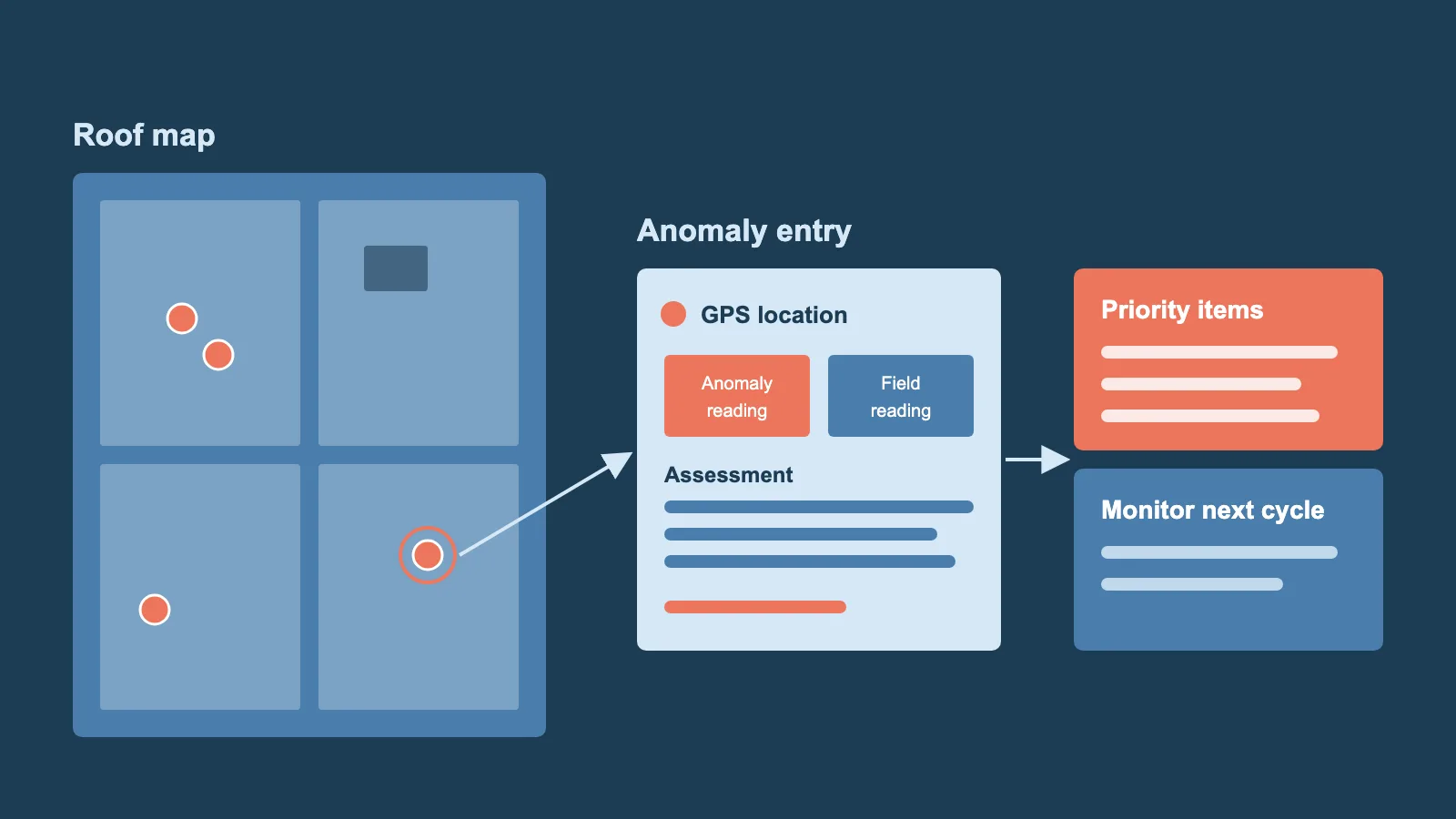
A thermal roof report opens on a map of your roof with anomaly markers spread across it. Each marker leads to an entry with its location and temperature readings. Blue Nose Aerial Imaging of Tampa Bay writes each report so the next step sits on the page, and the order you read it in decides how quickly a roofer can act on it.
Start with the roof map
The roof map is an orthomosaic, one stitched image of the whole roof, with the thermal overlay on top and every anomaly marked. The map is worth reading before you open a single anomaly entry, because clusters tell you more than any one marker does. Several warm areas along the same seam line usually point to one problem, and a spread of markers around a single drain usually traces back to that drain.
How the flight runs and what the camera captures are covered in our drone roof inspection workflow.
What each anomaly entry tells you
Each anomaly has its own entry in the report. The entry gives the GPS location and the calibrated temperature reading for the anomaly alongside the surrounding field temperature, followed by a written assessment of what the pattern likely means.
The figure that carries the most information is the difference between the anomaly reading and the field reading. A wide difference on a broad, irregular patch after sunset is the classic pattern of wet insulation. A narrow warm line that follows a lap usually points to the seam itself. Our drone thermal imaging guide explains how a radiometric camera records those readings.
Warm spots with a dry explanation
Some warm spots on a thermal image have nothing to do with water. Rooftop units and exhaust vents run warm on their own, and dark patching material holds the day’s heat longer than the membrane around it.
We mark those areas in the report so they stay off the roofer’s work list. When an entry notes a likely non-moisture cause, the orthomosaic usually shows the unit or the patch responsible.
Priority and the next step
Every anomaly entry ends with a recommended next step and says whether the area is a priority item or one to monitor on the next inspection cycle. The next step is specific, such as a core cut at the marker nearest the east drain or a closer look at the flashing on the north curb.
The priority call reflects what sits below the roof. A large wet area above occupied office space is a priority item, while a small warm spot over a storage bay can go on the monitor list even when it reads warmer. A facility team can take the priority items to the roofer this month and check the monitor list again at the next inspection.
Handing the report to your roofer
We write the report for the roofer as much as for the owner. A roofer who arrives with GPS-tagged markers can plan core cuts and moisture probes at the flagged locations. The roofer confirms whether each area is wet or dry, and those confirmed findings set the repair scope.
We provide the imagery and the report. Your roofing contractor confirms conditions on the roof and writes the repair plan. Our commercial roof inspection guide covers where a thermal flight fits in a full roof program.
Keeping the report after the repair
A dated report keeps working after the repair is done. Our next flight can be compared marker by marker against this one to show whether a repaired area dried out. Facility teams on a preventative maintenance program use each report as the baseline for the next one, and the same dated record supports an insurance claim if a storm damages the roof later.
Where we fly
We fly commercial roofs across Pinellas, Hillsborough, Manatee, Sarasota, Hardee, and DeSoto Counties, from St. Petersburg and Clearwater to Tampa, Brandon, Bradenton, and Venice.
Frequently Asked Questions
What does the temperature difference on a thermal roof report mean?
The temperature difference compares the anomaly with the dry roof beside it. A wide difference on a broad, irregular patch after sunset often points to wet insulation below the membrane. The roofer confirms the cause with a core cut or a moisture probe.
Why are some warm spots on the report marked as dry?
Rooftop units and dark patching material run warm for reasons unrelated to moisture. We note those areas in the report so the roofer does not spend time on them.
Does a thermal roof report confirm that the roof is wet?
A thermal report shows temperature patterns that suggest likely wet areas. The roofing contractor confirms each finding on the roof before any repair decision.
How do facility teams use a thermal roof report for budgeting?
The report separates priority items from areas to monitor on the next inspection cycle. Facility teams usually repair the priority items first and recheck the monitor list at the next flight, with the dated report as the comparison point.
Request a Thermal Roof Inspection

Rob Smith
Director of Operations, FAA Part 107 certified
Every roof inspection starts with a quick conversation. Rob Smith, our Director of Operations, will help you scope the right inspection and answer your questions on a call.
What to expect on the call:
- We learn about your roof and what you need to document.
- We recommend the right inspection scope and timeline.
- You get a clear, no-pressure quote.
You can also reach the team at 941-376-3396.