
A roof claim moves on documentation. When the property owner, the roofing contractor, and the insurance adjuster all look at the same dated aerial record, the conversation about what happened and what it will take to fix gets shorter. Blue Nose Aerial Imaging of Tampa Bay flies commercial roofs across the Tampa Bay area and delivers the imagery that owners, roofers, and adjusters work from during a claim.
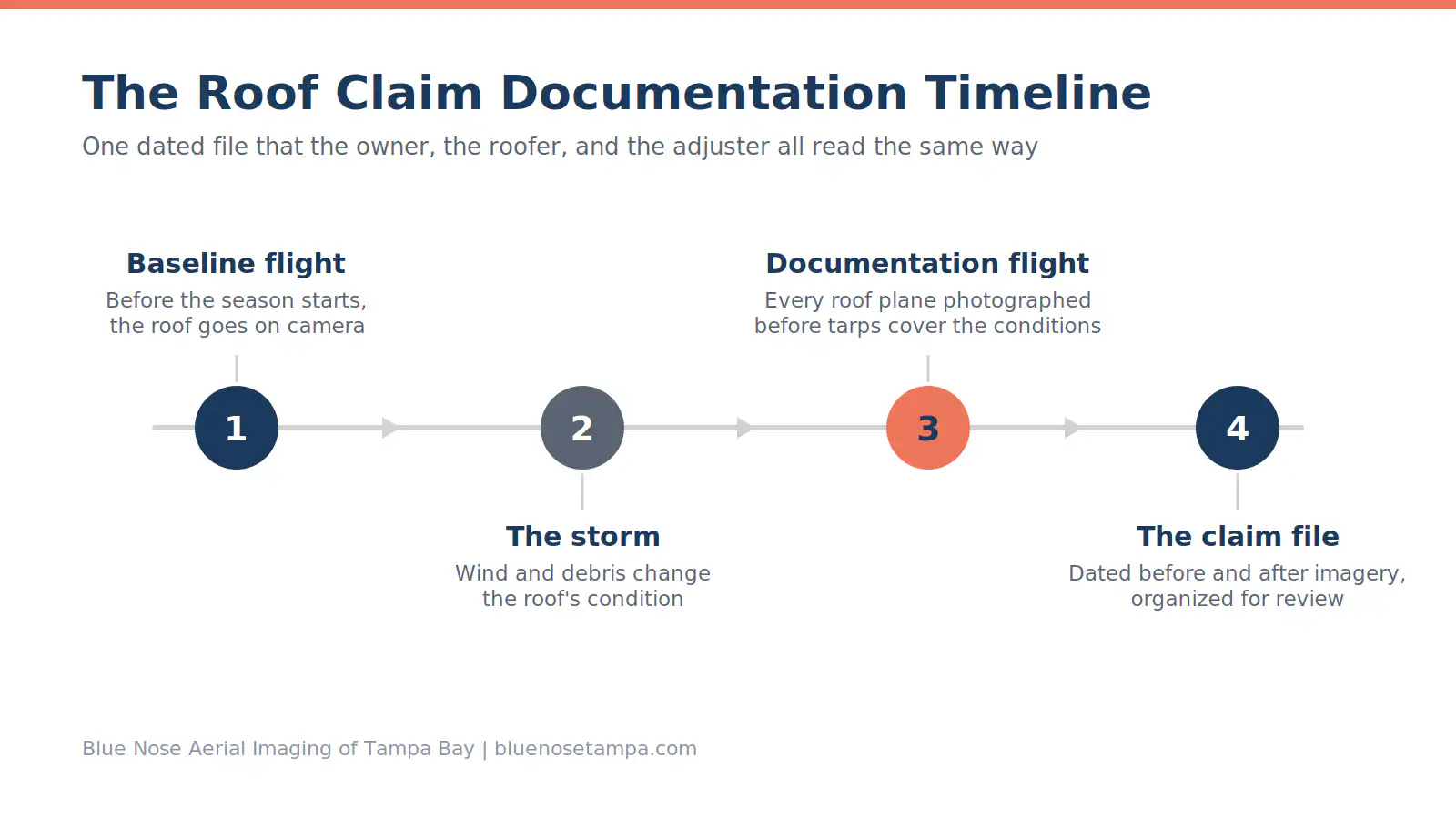
What a roof claim needs from an inspection record
Spot photos from a phone cover the spots someone could reach. A claim file works better when the record covers the whole roof, carries a date, and shows enough detail to place each condition on the structure.
Four things make an inspection record useful in a claim. The imagery is dated, so nobody argues about when conditions existed. The coverage is complete, so the file shows the undamaged areas along with the damaged ones. The detail is close enough to read seam separation, punctures, and displaced material. And the angles are repeatable, so a later flight can show the same view after repairs or after the next storm.
Before the storm: the baseline record
The strongest claim documentation starts before anything happens. A dated baseline flight from before hurricane season gives the adjuster a before picture, and the before picture settles the pre-existing damage question faster than memory or maintenance receipts can. We cover that flight in our guide to pre-storm roof documentation for Tampa Bay commercial properties.
After damage: documenting conditions without walking the roof
After a storm, the roof is the last place a person should stand. Wet insulation hides under membrane that looks walkable, and a compromised deck does not announce itself. A drone documents every plane of the roof without adding foot traffic to a structure nobody has cleared yet.
Timing has a second purpose after damage. Tarps and emergency dry-in work protect the building, and they also cover the conditions underneath. A flight before temporary repairs go on preserves the record of what the storm did. Our storm damage roof inspection service covers the post-event inspection itself.
What Blue Nose Aerial Imaging of Tampa Bay delivers
A documentation flight produces high-resolution stills of each roof plane, detail captures at every damage location, an overview image that places each detail shot on the structure, and a dated summary that organizes the set. Where moisture intrusion is the question, we add thermal imaging: temperature differences across the membrane can point to wet insulation, and your roofer confirms with moisture testing before repair scope gets written. The same capture work runs through our commercial roof inspections across Tampa Bay.
We provide imagery and reporting for documentation purposes. Licensed adjusters make claim decisions, and your roofing contractor writes the repair scope. Our part is a clear, dated record that all sides can read the same way.
Where aerial documentation fits in the claims process
Your policy sets the reporting deadlines and your insurer runs its own process. Aerial documentation fits around both. The owner reports the claim and shares the record with the carrier. The roofer uses the same imagery to write a repair scope grounded in what the roof shows. The adjuster reviews conditions against a complete file instead of a handful of ground photos. One record serves three readers and cuts the rounds of back and forth.
Where we fly
We document commercial roofs across Pinellas, Hillsborough, Manatee, Sarasota, Hardee, and DeSoto Counties, including Tampa, St. Petersburg, Clearwater, Brandon, Bradenton, Sarasota, and Venice. If a storm has moved through and you need a roof documented, contact us and we will get you on the flight schedule.
Frequently Asked Questions
Can drone photos be used for an insurance claim?
Insurers accept photographic documentation as part of a claim file, and aerial imagery is photographic documentation with a date stamp and full roof coverage. Your insurer and your adjuster decide how any record is weighed. We organize the imagery so each condition is easy to locate, which is what reviewers need from it.
Should I document the roof before storm season or after damage?
Both flights are useful, and they do different work. A pre-season baseline shows the roof’s condition before any event, which settles pre-existing damage questions. A post-event flight records what changed. The pair reads stronger than either one alone.
Do you work with roofers and adjusters directly?
We deliver imagery to whoever the property owner designates, and roofers and adjusters both use it. Roofing contractors write repair scope from it, and adjusters review conditions with it. We do not act as an adjuster, and we do not negotiate claims.
How soon after a storm can you fly?
We schedule post-storm documentation flights as soon as weather and airspace allow, often within days. Temporary flight restrictions sometimes follow a major storm, and we plan around them. Earlier is better, since temporary repairs cover conditions once they go on.
Request a Roof Documentation Flight
Rob Smith
Director of Operations, FAA Part 107 certified
Every roof inspection starts with a quick conversation. Rob Smith, our Director of Operations, will help you scope the right inspection and answer your questions on a call.
What to expect on the call:
- We learn about your roof and what you need to document.
- We recommend the right inspection scope and timeline.
- You get a clear, no-pressure quote.
You can also reach the team at 941-376-3396.