
Drone and thermal roof inspections for commercial properties across the Tampa Bay no-mileage service area, with same-week scheduling and documentation built for capital planning, insurance, and roofing-contractor handoff.

A commercial roof rarely fails all at once. It fails at a seam, a flashing detail, or a penetration, and the water tracks sideways under the membrane for months before it shows up as a stain on a tenant’s ceiling. By the time a facility manager sees the leak, the wet insulation underneath has usually spread well past the visible damage, and the repair bill has grown with it. The point of a commercial roof inspection is to find those problems while they are still small, and to document the roof’s condition well enough to plan, budget, and defend a claim.
For facility managers and commercial property managers across Pinellas, Hillsborough, Manatee, and Sarasota, drone-based inspection has changed what that documentation looks like. This guide explains what a commercial drone roof inspection actually captures, how thermal imaging finds trapped moisture before it becomes a leak, when each type of inspection makes sense, and how to use the data for maintenance planning, insurance claims, and roofing-contractor bids.
Why Commercial Roofs Need Regular Inspection in Florida
Florida is hard on commercial roofs. Most commercial buildings carry low-slope or flat membrane roofs, such as TPO, EPDM, modified bitumen, or built-up systems. Those membranes live outdoors in intense ultraviolet exposure, daily heat cycling, heavy summer rain, and an annual hurricane season that can lift flashing, drive debris, and open seams.
The failure modes are predictable. Ponding water sits in low spots that never fully drain. Seams separate as the membrane expands and contracts. Flashing pulls away from parapets and curbs. Penetrations around HVAC units, vents, and drains crack and start to admit water. None of these are dramatic on day one, and all of them get expensive if no one is looking.
Regular inspection matters for three practical reasons. First, catching a seam or flashing problem early turns a small repair into a maintenance line item instead of a full roof replacement. Second, a documented inspection history is what supports a warranty claim when a manufacturer or installer pushes back. Third, a pre-storm baseline is often the difference between a clean insurance claim and a denied one after a hurricane, because the adjuster can see what the roof looked like before the event.
What a Drone Commercial Roof Inspection Actually Captures
A drone roof inspection is not a single photo. It is a documented dataset of the entire roof surface, captured from above without anyone setting foot on the membrane.
A standard inspection produces two layers of data. The first is high-resolution visual imagery. The drone flies a programmed grid over the roof and captures overlapping photos that are stitched into a single orthomosaic image, a sharp top-down map of the whole roof where every drain, seam, penetration, and patch is visible and located. A facility manager can zoom into a cracked pitch pan or a lifted seam at the corner of the building without climbing anything.
The second layer, on a thermal inspection, is radiometric thermal imagery. A thermal sensor records the surface temperature across the roof, and that temperature map reveals problems the eye cannot see, which is the subject of the next section.
Both layers are time-stamped and GPS-tagged, so the inspection is a dated record of the roof’s condition on a specific day. That record is what makes the data useful for capital planning, warranty disputes, and insurance claims.
How Thermal Imaging Finds Trapped Moisture
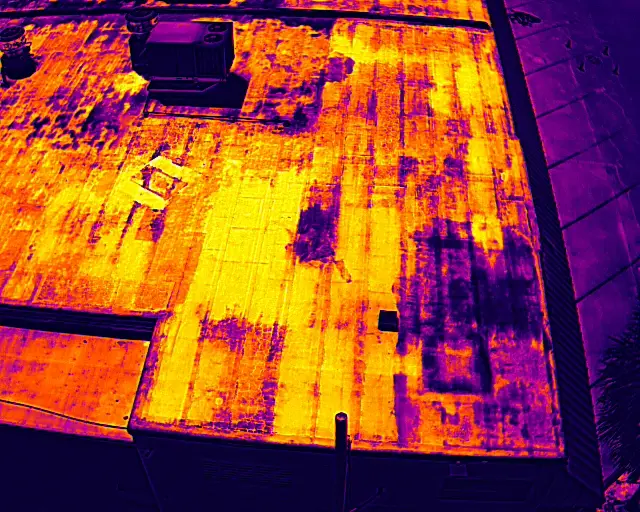
The most valuable thing a drone adds to roof inspection is the ability to find wet insulation under an intact membrane, before it becomes a visible leak.
During the day, the sun heats the entire roof. Dry insulation releases that heat quickly after sunset. Insulation that has absorbed water holds the heat longer, because water has a high thermal mass. A thermal scan flown in the early evening, after the roof has had a full day of sun and the dry areas have begun to cool, shows the wet areas as warm signatures standing out against the cooler dry membrane.
Those warm patches map the extent of trapped moisture under the membrane. The visible surface can look perfectly fine while the insulation below it is saturated across hundreds of square feet. A thermal inspection finds that hidden moisture and shows its boundaries, so a repair can be scoped to the actual wet area rather than guessed at or discovered by tearing the roof open.
This kind of thermal moisture inspection is non-destructive. Nothing is cut, cored, or removed. A drone thermal inspection documents the temperature patterns consistent with trapped moisture, and the roofing professional who acts on the data confirms the specific repair scope. The drone thermal imaging guide covers the deeper mechanics of thermal work in depth, including solar farms and building envelopes.
The Safety and Coverage Problem Drones Solve
Traditional commercial roof inspection means sending a person onto the roof with a ladder, often onto a tall flat roof crowded with rooftop equipment, unguarded edges, and fragile skylights. Falls are the leading cause of death in construction and building maintenance work, and low-slope commercial roofs are among the more dangerous places to put an inspector.
A drone keeps people off the roof for the routine look. The pilot stays on the ground, the aircraft covers the entire surface in a fraction of the time a walking inspection takes, and the membrane is never walked on, so the inspection itself does not add wear or risk puncturing the roof. For a large or multi-building property, the time difference is significant. A campus that would take a full day to walk and photograph can be flown and documented in a couple of hours.
The coverage is also more complete. A person on the roof photographs what they happen to notice. A programmed drone grid captures everything uniformly, including the field of the roof between the obvious trouble spots, so nothing is skipped because an inspector did not walk to that corner.
When Each Type of Inspection Makes Sense
Commercial roof inspections fall into a few recurring situations, and the right scope depends on the situation.
Preventive maintenance and capital planning
Facility managers and property managers schedule routine inspections, typically once or twice a year and after major storms, to track roof condition over time and plan capital budgets. The drone roof inspection guide walks through the flight and reporting process step by step. The drone roof inspection guide walks through the flight and reporting process step by step. A documented baseline plus periodic re-flights shows how the roof is aging, where problems are developing, and roughly how much service life remains. That record turns roof replacement from a surprise into a planned, budgeted project.
Pre-purchase and due diligence
Buyers and asset managers commission a roof inspection before closing on a commercial property, so the roof’s real condition is known before the deal is signed. A drone inspection produces that documentation quickly, without the scramble to coordinate roof access during a tight due-diligence window.
Insurance claims, before and after a storm
A pre-storm baseline documents the roof’s condition before hurricane season, and a follow-up flight documents new damage against that baseline after a storm. The storm damage roof inspection guide covers what to document and when. The storm damage roof inspection guide covers what to document and when. Adjusters increasingly accept time-stamped, GPS-tagged aerial documentation as part of the claims process, and the before-and-after pairing is far harder to dispute than a single post-storm photo.
Roofing-contractor scoping and bids
Roofing contractors use drone imagery and thermal data to scope repairs and prepare bids without sending a crew to walk the roof first. The thermal map shows the extent of wet insulation, and the visual orthomosaic documents the layout and condition, so the contractor can quote the actual scope of work. Roofing contractors across Tampa Bay work with Blue Nose Aerial Imaging of Tampa Bay this way.
Some properties need more than the roof documented. For building facades, parking structures, rooftop equipment, and site drainage, the commercial drone inspection guide covers the whole-property scope alongside the roof.
Using Roof Inspection Data for Insurance Claims
After a hurricane, commercial property claims often come down to a question of what damage the storm caused versus what was pre-existing wear. That is exactly the question a documented inspection history answers.
A pre-storm baseline flight establishes the roof’s condition before the event. A post-storm flight documents the new damage, located and time-stamped, against that baseline. The two datasets together give an adjuster a clear, dated record rather than an argument, and many commercial property managers across Tampa Bay now schedule a baseline flight before hurricane season specifically to protect their claims position.
Aerial imagery documents the condition of the roof. It does not, by itself, certify the cause of damage or serve as a sealed engineering report. Where a claim requires a structural determination or a sealed report, a licensed roofing professional or engineer makes that call, using the documentation as evidence. Blue Nose Aerial Imaging of Tampa Bay provides the documentation layer, and the professional of record makes the determination.
Why Blue Nose Aerial Imaging of Tampa Bay for Commercial Roof Inspections
A Part 107 certificate and a consumer drone are inexpensive, so the range of operator quality is wide. For a commercial roof inspection that may end up supporting an insurance claim or a capital decision, the operator and the data both need to hold up.
Blue Nose Aerial Imaging of Tampa Bay operates under FAA Part 107 authority with commercial liability insurance, thermal-capable enterprise sensors, and a documented, aviation-grade approach to flight planning and safety. Our Director of Operations holds a master’s degree in Aeronautics with a specialization in Aviation Human Factors, an FAA Part 107 remote pilot certificate, and a current Airline Transport Pilot certificate as a 747 captain. The standards behind each flight come from commercial aviation, not from a weekend with a consumer drone.
Each inspection is delivered with the imagery, the thermal data where applicable, and documentation of how and when the roof was flown, in a format a facility manager, a roofing contractor, or an adjuster can use directly.
Where Blue Nose Aerial Imaging of Tampa Bay Inspects Commercial Roofs
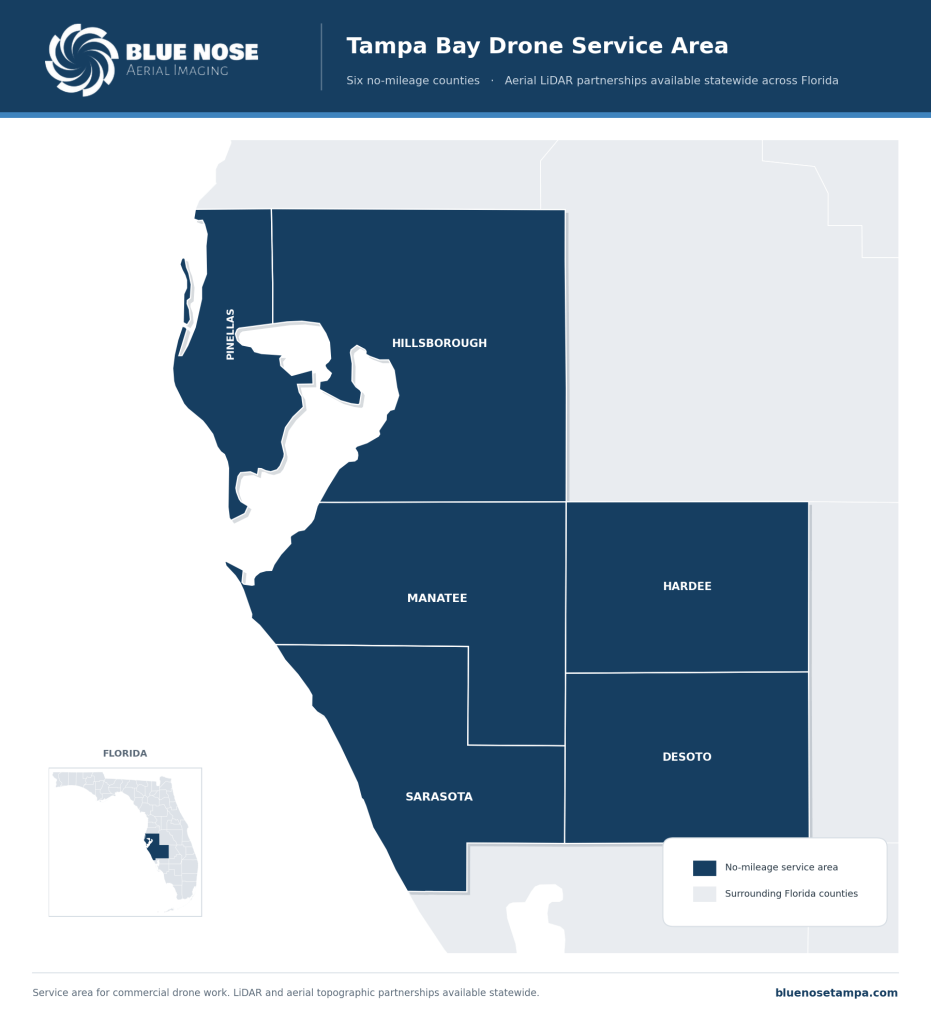
Blue Nose Aerial Imaging of Tampa Bay provides commercial roof inspections with no mileage charges across six counties.
For larger commercial portfolios and specialized thermal work such as solar farms and building envelopes, Blue Nose Aerial Imaging of Tampa Bay also takes projects beyond the no-mileage area where the project scope supports it.
What Happens When You Schedule an Inspection
Blue Nose Aerial Imaging of Tampa Bay starts with a short scoping call to understand the property, the roof type, and what the inspection needs to support, whether that is routine maintenance, a pending sale, an insurance baseline, or a contractor bid. From there we provide a written scope and a price covering the flight, the data processing, and the deliverable format.
Most commercial roof inspections can be scheduled within the same week, subject to weather and airspace authorization. Thermal scans are timed for the right conditions, usually a late-afternoon or early-evening flight after a sunny day, so the moisture signatures are clear.
Frequently Asked Questions About Commercial Roof Inspections
What is a commercial roof inspection by drone?
A commercial roof inspection by drone uses an uncrewed aircraft to capture the entire roof surface from above, producing a high-resolution visual map of the roof and, on a thermal inspection, a temperature map that reveals trapped moisture under the membrane. The inspection is documented, time-stamped, and located, and it is completed without anyone walking the roof. Facility managers use it for maintenance planning, due diligence, insurance documentation, and roofing-contractor scoping.
How does drone thermal imaging find roof leaks?
It does not see water, it sees heat. Wet insulation under the membrane holds the day’s heat longer than dry insulation, so an early-evening scan lights up the wet areas as warm patches against the cooler roof and maps how far the moisture has spread, usually before any leak reaches a ceiling. Nothing is cut or cored to find it.
Is a drone roof inspection as reliable as walking the roof?
For documenting condition and finding moisture, a drone inspection is generally more complete than a walking inspection, because a programmed flight covers the entire roof uniformly and a thermal sensor sees subsurface moisture the eye cannot. A walking inspection still has a place for close hands-on assessment of a specific detail, and many properties combine the two. The drone finds and documents the problem areas, and a roofing professional inspects those specific spots up close.
How often should a commercial roof be inspected in Florida?
A common schedule for Florida commercial roofs is twice a year, once before hurricane season and once after, plus an additional inspection after any major storm. Florida’s heat, ultraviolet exposure, and storm season age membranes faster than milder climates, so a regular documented inspection history is worth more here than in most parts of the country.
Can drone roof inspection data be used for an insurance claim?
Yes, as documentation. Adjusters increasingly accept dated, GPS-tagged aerial imagery, and a before-and-after pairing, a baseline shot before the storm and a follow-up after, carries far more weight than a lone post-storm photo. The imagery records condition; it does not assign the cause of damage or stand in for a sealed engineering report, which stays with a licensed roofing professional or engineer.
How much does a commercial drone roof inspection cost?
Commercial aerial data capture, including roof inspections, typically ranges from $750 to $3,500 per site, depending on the size of the roof, whether thermal imaging is included, and the deliverable format. A single-building visual inspection sits at the lower end, while a large multi-building campus with full thermal coverage sits higher. The dedicated drone roof inspection cost guide breaks the cost factors down in detail.
What counties does Blue Nose Aerial Imaging of Tampa Bay cover for commercial roof inspections?
The no-mileage area is six counties: Pinellas (St. Petersburg, Clearwater), Hillsborough (Tampa, Brandon), Manatee (Bradenton, Lakewood Ranch), Sarasota (Sarasota, Venice, North Port), Hardee (Wauchula, Bowling Green), and DeSoto (Arcadia). Larger portfolios and specialized thermal work, such as solar fields and building envelopes, are taken on beyond those counties where the scope supports the travel.
Do you work with roofing contractors?
Yes. Contractors across Tampa Bay use Blue Nose Aerial Imaging of Tampa Bay imagery and thermal data to scope repairs and build bids before a crew ever sets foot on the roof, with the contractor staying the roofing professional of record. Blue Nose Aerial Imaging of Tampa Bay supplies the documentation; the bid and the repair plan are the contractor’s.
Request a Roof Inspection Quote

Rob Smith
Director of Operations, FAA Part 107 certified
Every commercial roof inspection starts with a quick conversation. Rob Smith, our Director of Operations, will help you scope the right inspection for your property and answer your questions on a call.
What to expect on the call:
- We learn about your property, the roof type, and what the inspection needs to support.
- We recommend the right inspection scope, including thermal where it helps.
- You get a clear, no-pressure quote.
You can also reach the team at 941-376-3396.