
A commercial roof rarely fails all at once. It fails at a seam, at a flashing detail, at a drain that stopped moving water, or at a puncture nobody saw, and the water damage spreads from there. Preventative maintenance exists to catch those conditions while they are small, and it only works if someone looks at the whole roof on a schedule. Blue Nose Aerial Imaging of Tampa Bay gives Tampa Bay facility teams that look, in full, on every cycle.
Why preventative maintenance beats reactive repair
Reactive repair means the leak announces the problem, and by then the problem has been running for months. Wet insulation and interior damage ride along with the membrane defect that started it. Roofing manufacturers write maintenance requirements into their warranty terms for the same reason: a maintained roof reaches its service life, and a neglected one gets replaced early.
What an aerial maintenance inspection covers
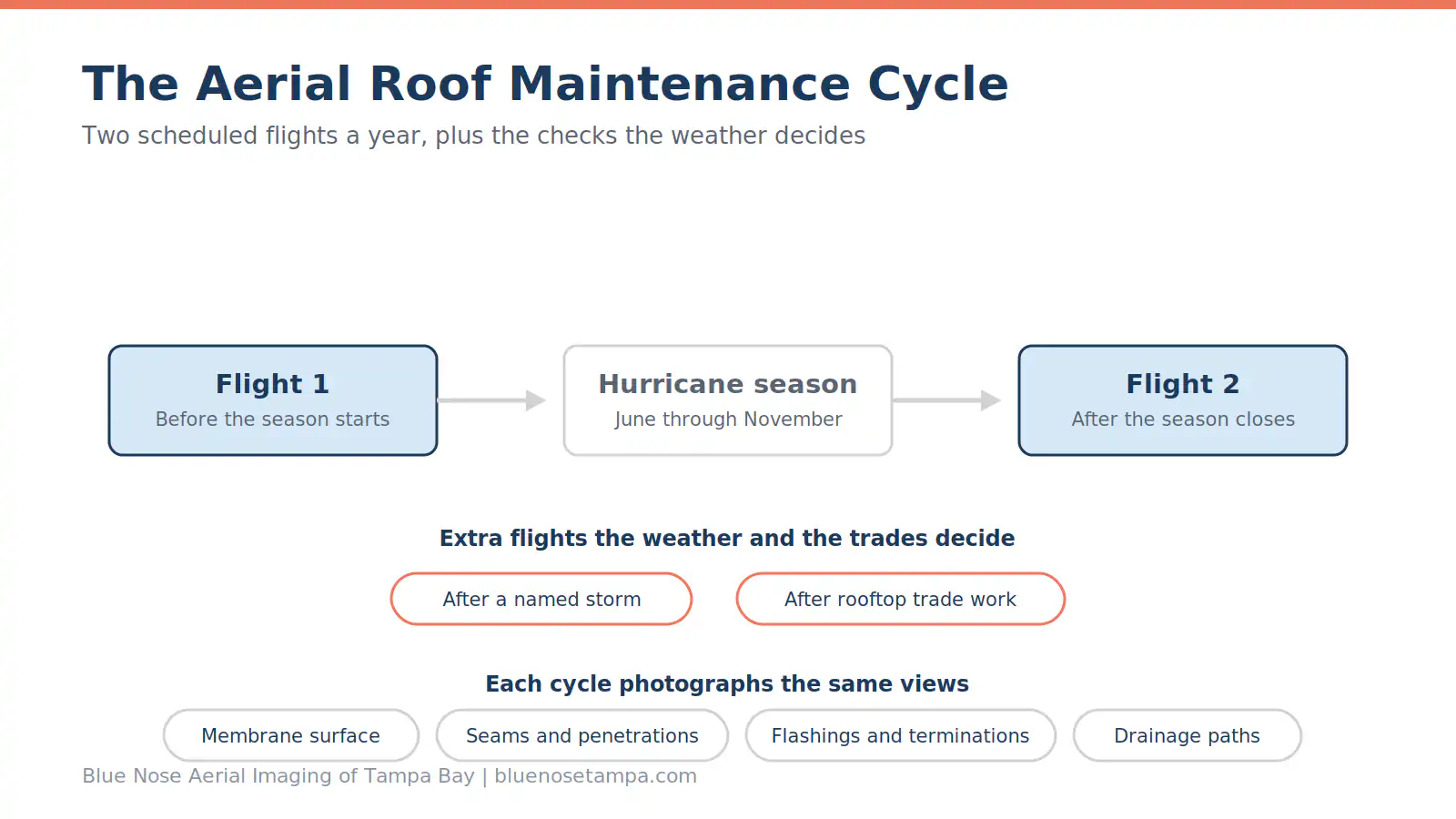
On each cycle we photograph the full membrane surface, the seams and penetrations, the flashings and terminations, and the drainage paths. The imagery shows ponding patterns, debris accumulation, displaced material, and wear around rooftop equipment, and it shows them across the whole roof rather than along the walk path someone happened to take.
Every capture is dated and organized by roof area, and we repeat the same angles on the next visit. Your roofer compares this cycle against last cycle instead of comparing memory against memory.
How often to inspect
Twice a year fits most Tampa Bay commercial roofs: one flight before hurricane season and one after it. We add a flight after any named storm that passes near the property, and after rooftop trade work such as an HVAC replacement, since new penetrations and fresh foot traffic are where new damage tends to start.
Thermal imaging on a maintenance cycle
Moisture that got under the membrane does not show in a photograph. A thermal pass in the right conditions can show temperature differences that point to wet insulation, which tells your roofer where to test before a small area becomes a tear-off. Our guide to drone thermal imaging for Florida commercial roofs covers how those flights work.
The documentation trail
A maintenance program produces a condition record along with the repairs. Dated imagery from every cycle supports capital planning, because a roof that is trending toward replacement shows the trend on camera. The same file answers manufacturer questions, and manufacturers ask for maintenance records when a warranty claim comes in.
Getting a program started
We fold aerial inspections into the maintenance program your roofing contractor already runs, or we help a facility team start one from the current condition of the roof. Our commercial roof inspections hub covers the inspection service itself, and our breakdown of commercial roof inspection cost covers what owners typically budget. Contact us and we will set up the first cycle.
Frequently Asked Questions
How often should a commercial roof be inspected?
Twice a year works for most Tampa Bay commercial roofs, once before hurricane season and once after it. We add a flight after any named storm that passes near the property and after rooftop trade work. Your roofer may set a different rhythm for hands-on work, and the aerial cycle runs alongside it.
Does an aerial inspection replace my roofing contractor?
No. Your roofing contractor puts hands on the roof, tests suspect areas, and performs the repairs. Our flights add the full-roof view, the dated record, and the between-visit coverage that hands-on inspections do not reach on their own.
What does thermal imaging add to a maintenance program?
Thermal imaging can show temperature differences across the membrane that point to wet insulation below the surface. That directs your roofer to the areas worth testing, so moisture problems get found while the repair is still a patch instead of a replacement section.
What kinds of buildings fit this program?
Flat and low-slope commercial roofs get the most from aerial cycles: warehouses, retail centers, office buildings, and multifamily properties. Metal and membrane systems both photograph well, and large footprints are where walking inspections leave the most unseen.
Request a Roof Inspection Program
Rob Smith
Director of Operations, FAA Part 107 certified
Every roof inspection starts with a quick conversation. Rob Smith, our Director of Operations, will help you scope the right inspection and answer your questions on a call.
What to expect on the call:
- We learn about your roof and what you need to document.
- We recommend the right inspection scope and timeline.
- You get a clear, no-pressure quote.
You can also reach the team at 941-376-3396.