
How a commercial drone roof inspection works, what you receive, and which buildings benefit most, across the six-county Tampa Bay no-mileage area.
A drone roof inspection answers a simple question without putting anyone on the roof: what condition is this roof actually in, and where are the problems. For commercial properties across Tampa Bay, that has become the practical way to inspect a roof on a schedule, document its condition, and decide what to repair before a small issue turns into a leak.
This guide stays on the drone roof inspection itself: how the flight works, what the deliverable includes, which buildings and roof types it suits, and how it compares to a traditional walking inspection. For the broader picture, the commercial roof inspection pillar owns the insurance workflow and the capital-planning case, and the drone thermal imaging guide owns the thermal moisture technique. This piece points to both rather than repeating them.
How a Drone Roof Inspection Works
A drone roof inspection follows a consistent process. The drone roof inspection workflow article walks through a full inspection from flight plan to delivered report, and the storm damage roof inspection guide covers the post-storm case. The drone roof inspection workflow article walks through a full inspection from flight plan to delivered report, and the storm damage roof inspection guide covers the post-storm case.
Scope and plan
It starts with a short scoping conversation about the building, the roof type and size, and what the inspection needs to support. From there, Blue Nose Aerial Imaging of Tampa Bay plans the flight, including any airspace authorization the location requires, and schedules it for suitable weather, and for the right time of day if thermal imaging is part of the scope.
Fly and capture
On site, the drone flies a programmed grid above the roof and captures overlapping high-resolution images of the entire surface. The pilot stays on the ground throughout. The overlapping frames are then processed into an orthomosaic, a single sharp top-down map of the roof where every seam, drain, penetration, and patch is visible and located. If the scope includes thermal, a radiometric scan is added to map areas consistent with trapped moisture.
Deliver the inspection
The finished inspection is delivered as documented imagery, time-stamped and located, with the thermal layer where applicable, in a format the facility manager or roofing contractor can use directly.
What You Receive
A drone roof inspection produces more than a set of photos. The core deliverable is the orthomosaic map of the whole roof, plus high-resolution detail imagery of any problem areas, such as separated seams, cracked penetrations, displaced flashing, ponding spots, and storm damage. Where thermal is included, a thermal map shows the areas consistent with trapped moisture under the membrane. Everything is dated and located, so the inspection stands as a record of the roof’s condition on the day it was flown. That record is what makes the data useful later for capital planning, warranty conversations, and insurance claims.
Which Commercial Buildings Benefit Most
A drone roof inspection fits almost any commercial roof, and it is most valuable on buildings that are large, tall, or hard to access safely. Large flat roofs on warehouses and distribution centers are a natural fit, since walking and photographing acres of membrane by hand is slow and incomplete. Retail centers, office buildings, industrial facilities, institutional buildings, and commercial multifamily or condominium properties all benefit for the same reasons.
The membrane type does not limit the method. TPO, EPDM, modified bitumen, built-up, and metal roofs all photograph and scan the same way from above. The buildings where a drone changes the math most are the ones that are hardest to inspect on foot: steep or fragile roofs, roofs ringed by skylights and rooftop equipment, and roofs tall enough that ladder or lift access is a project in itself. Any roof that is dangerous to walk, crowded with obstructions, or simply too large to cover thoroughly by hand is a strong candidate.
Drone Inspection Versus a Traditional Walking Inspection
A traditional roof inspection sends a person onto the roof to look and photograph. That approach still has value for close, hands-on assessment of a specific detail, and the strongest programs often combine the two.
Where the drone wins is safety, speed, coverage, and documentation. No one is exposed to a fall hazard for the routine look. A large roof is covered in a structured flight in a fraction of the walking time. The capture is uniform across the whole roof rather than limited to where an inspector chose to walk. The membrane is never walked on, so the inspection does not add wear or risk a puncture. And the result is a documented, dated dataset rather than a folder of loose photos.
What a Drone Roof Inspection Documents
A drone roof inspection is a documented record of the roof’s visible condition, with the thermal layer showing where moisture is likely trapped under the membrane. It is not a sealed engineering report, a structural certification, or a warranty determination. Those calls belong to the licensed roofing professional or engineer, who uses the inspection as the evidence behind them. Blue Nose Aerial Imaging of Tampa Bay documents the roof; the licensed professional acts on what it shows.
Where Blue Nose Aerial Imaging of Tampa Bay Inspects
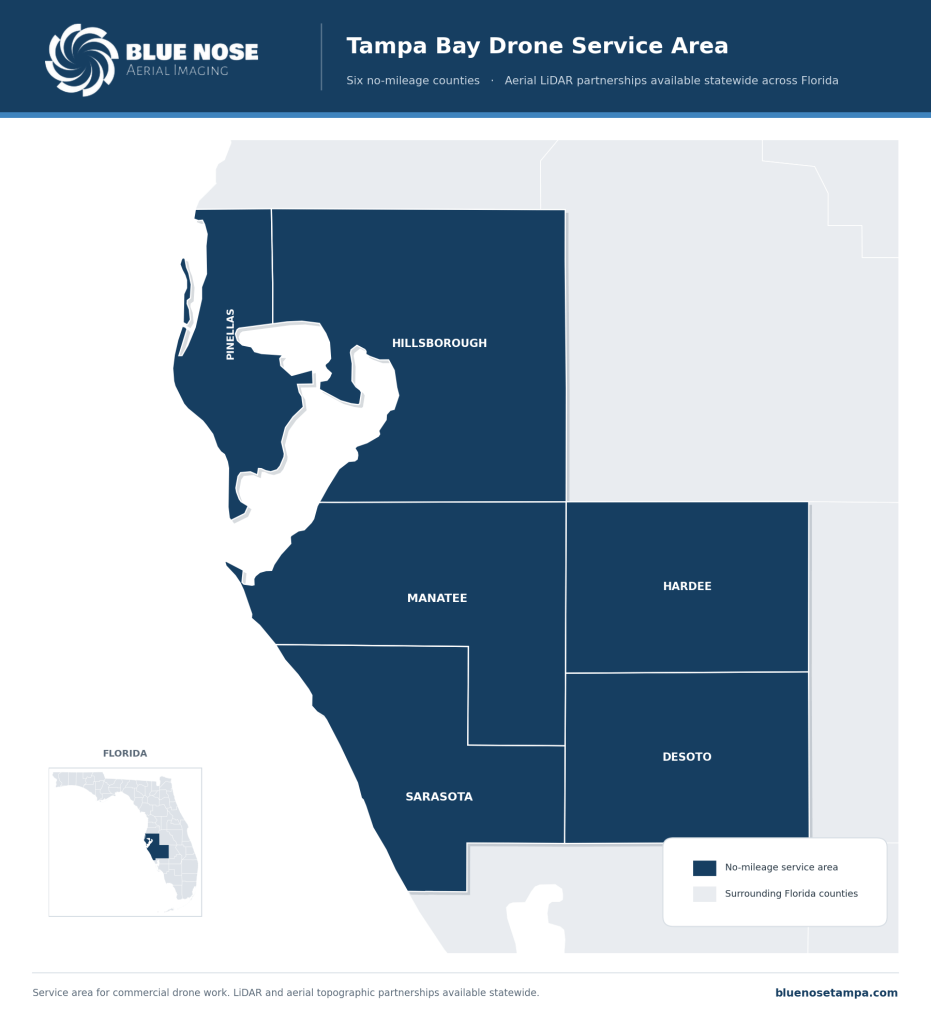
Blue Nose Aerial Imaging of Tampa Bay provides commercial drone roof inspections with no mileage charges across six counties.
Larger portfolios beyond that area are scoped per project.
Why Blue Nose Aerial Imaging of Tampa Bay
Blue Nose Aerial Imaging of Tampa Bay operates under FAA Part 107 authority with commercial liability insurance and thermal-capable enterprise sensors. Blue Nose Aerial Imaging of Tampa Bay is led on operations by a 747 captain who holds an Airline Transport Pilot certificate, an FAA Part 107 remote pilot certificate, and a master’s in Aeronautics focused on Aviation Human Factors. Each inspection is flown and documented to standards that hold up when the data has to support a capital decision or an insurance claim.
Frequently Asked Questions About Drone Roof Inspections
What is a drone roof inspection?
A drone roof inspection uses an uncrewed aircraft to photograph an entire roof from above and process the images into a documented, located map of the roof’s condition. It captures seams, drains, flashing, penetrations, and storm damage in high resolution, and it can include a thermal scan to find trapped moisture, all without anyone walking the roof.
How long does a commercial drone roof inspection take?
The flight itself usually takes from twenty minutes to a couple of hours depending on the size of the roof, and a large multi-building campus that would take a full day to walk can be flown in a fraction of that. Processing the imagery into the finished deliverable takes additional time after the flight, and the documented inspection is typically returned within a day or two.
Do you need roof access for a drone inspection?
No. The pilot operates from the ground and the aircraft covers the roof from above, so the inspection does not require roof access, ladders, or anyone on the membrane. That is one of the main safety advantages over a walking inspection.
Can a drone roof inspection include thermal moisture detection?
Yes. Adding a radiometric thermal scan reveals wet insulation under an intact membrane, which appears as a warm signature in an evening scan after a sunny day. The thermal layer maps the extent of trapped moisture before a leak becomes visible. The drone thermal imaging guide covers the technique in detail.
Is a drone roof inspection good enough for an insurance claim?
It provides dated, located documentation that adjusters increasingly accept, though the imagery documents condition rather than certifying the cause of damage, which stays with a licensed roofing professional or engineer. The full insurance workflow, including pre-storm baselines and post-storm comparisons, is covered in the commercial roof inspection pillar.
What does a drone roof inspection cost?
Commercial aerial data capture, including roof inspections, typically ranges from $750 to $3,500 per site, depending on roof size, whether thermal is included, and the deliverable format. The dedicated drone roof inspection cost guide breaks the factors down.
What areas does Blue Nose Aerial Imaging of Tampa Bay serve?
The no-mileage area is six counties: Pinellas, Hillsborough, Manatee, Sarasota, Hardee, and DeSoto. Larger portfolio projects beyond those counties are taken on where the scope supports the travel.
Request a Roof Inspection Quote

Rob Smith
Director of Operations, FAA Part 107 certified
Every commercial drone roof inspection starts with a quick conversation. Rob Smith, our Director of Operations, will help you scope the right inspection for your building and answer your questions on a call.
What to expect on the call:
- We learn about your building, the roof type, and what the inspection needs to support.
- We recommend the right inspection scope, including thermal where it helps.
- You get a clear, no-pressure quote.
You can also reach the team at 941-376-3396.